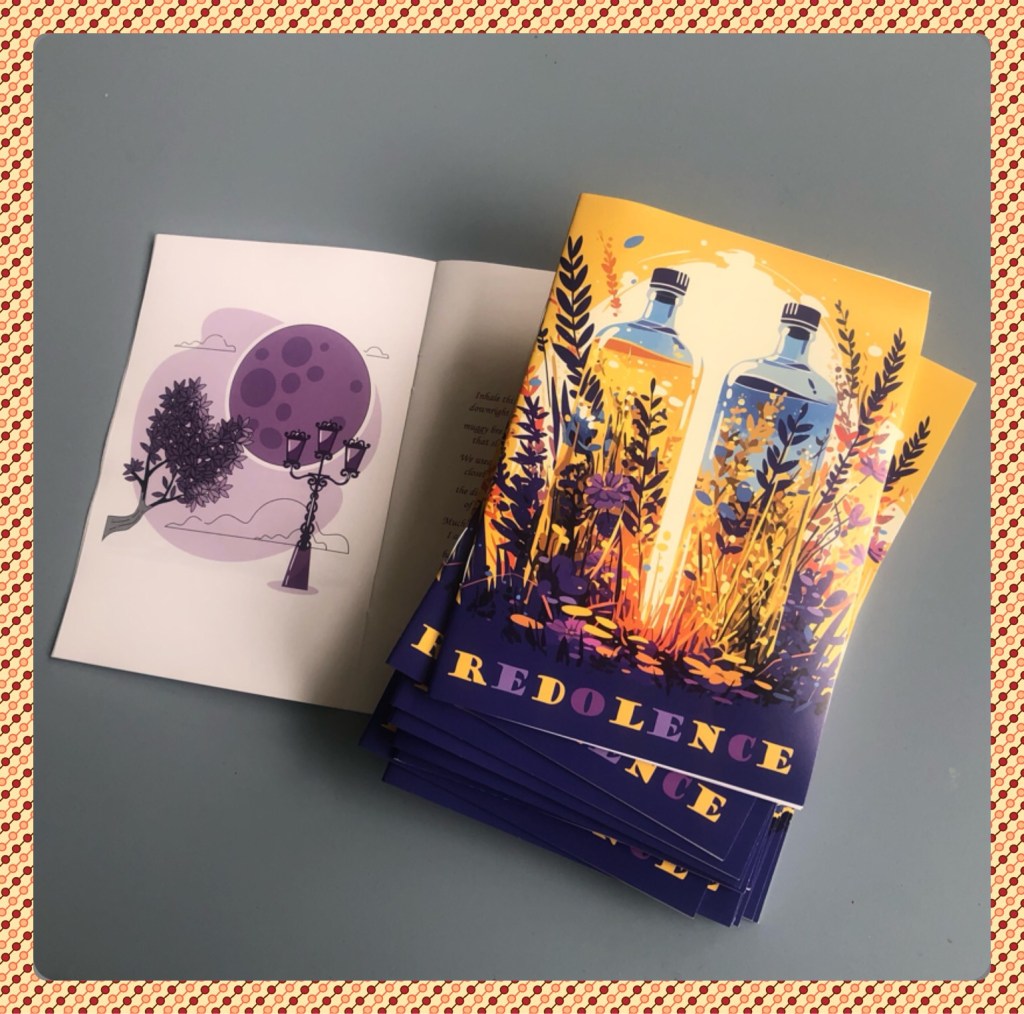
A creative collaboration – my first illustrated poetry booklet

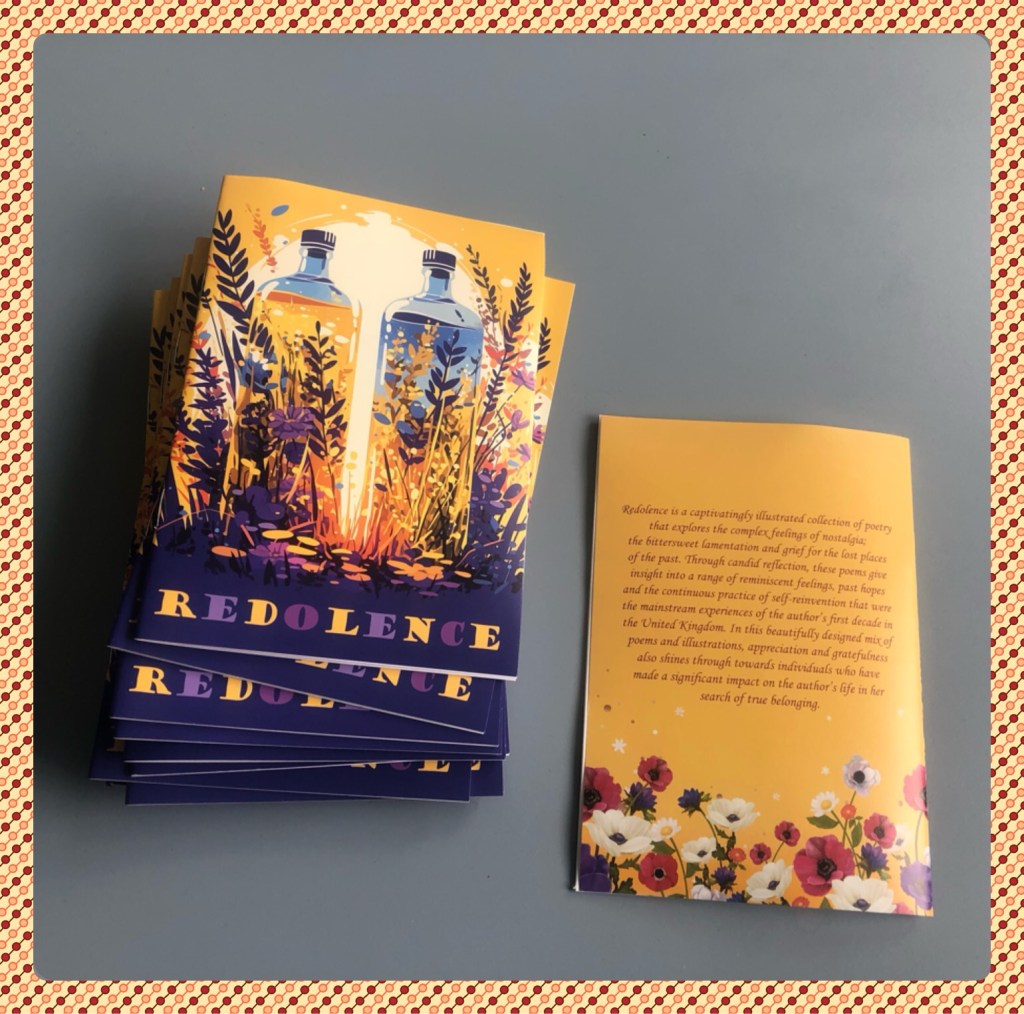
“Redolence is a captivatingly illustrated collection of poetry that explores the complex feelings of nostalgia; the bittersweet lamentation and grief for the lost places of the past. Through candid reflection, these poems give insight into a range of reminiscent feelings, past hopes and the continuous practice of self-reinvention that were the mainstream experiences of the author’s first decade in the United Kingdom. In this beautifully designed mix of poems and illustrations, appreciation and gratefulness also shines through towards individuals who have made a significant impact on the author’s life in her search of true belonging.”

It is an unusual practice to write your own blurb to the back of your book to encourage your audience to read your writing – yet I still think that only the author can persuasively promote a highly personal written, breathing world that encapsulates their complex emotional landscape. With this experimental mindset, I have embarked on the journey to write my own, expressive summary at the back of my booklet to highlight the overarching theme of the 12 poems that I cherry-picked for this compelling project.

There are 2 main themes in my pitch that forms the essence of this booklet. The mainstream emotion of this short poem compilation is revolving around melancholic nostalgia of past memories and the basic need to find true belonging after leaving behind the previous decade’s major milestones. The collection also functions as a heartfelt expression of gratitude towards certain individuals in my life who have made a significant contribution to who I am today – without them, I would not have the opportunity to write about all these past experiences that formed me to the core and supported me to develop a more realistic mindset that I am deeply thankful for.

Each writing has a corresponding illustration attached to it that was designed with the purpose of creating a visual representation of the written world I have tried to build into every poem with vivid and picturesque metaphors and alliterations. All of the illustrations maintain visual consistency throughout the booklet, enhancing the theme of each poem with the same style and shade.

As the majority of these writings in this booklet have been submitted to prestigious poetry competitions that are still ongoing, the first print set is purely reserved for family and friends until I know whether I am a winner on any of these competitions. My goal then is to send these booklets to literary magazines as an introductory tool of my work with the hope of getting them published to a wider audience.

Talking about appreciation as one of the themes of this poetry collection, I am very grateful to Lisa Phillips (Instagram @lisabuzzdesign) for the creative collaboration who has brought this booklet to life with the wonderful design.

How to develop healthier perspectives

Whether it’s to reduce worry levels or to lead a happier life, our cognitions should work for us and not against us. But mere decision to forcefully change our thoughts won’t make us feel better instantly. It is our cognitive distortions that we need to identify before we can decide on any meaningful action towards happiness.

We all have cognitive faults in our thinking that are not supporting our happiness. Cognitive Behavioural Therapy (CBT) teaches us that in order to feel better, we need to think better.
The first step towards total control is to catch our automated thoughts and identify any distortions in the process. Whether it’s black & white thinking, filtering, generalising, labelling or catastrophising; the main thing is to be completely aware of their existence.

Once you have captured your dominant cognitive distortions, then you can start the disputing process which is simply an exercise of a few questions to take your mind back to the present moment and find a more realistic view of your current situation.

How can you do that? Please see below an action plan that would be beneficial in this process:

1) Acknowledge the existence of unrealistic thoughts in your mind

We have millions of thoughts popping into our head every day and we tend to accept all of them as valid. This means that even the negative and unrealistic thoughts are regarded as true in our minds. We need to be aware that not our thoughts are worth accepting as some of them may not serve us but are actually causing damage in our emotional world. Identifying the thoughts that are making us upset are the ones that we need to pay close attention to.

2) Find evidences against your unrealistic thoughts

Once the thoughts that are on the unrealistic edge of our thinking are identified, we can then start to work with the different type of distortions. Whether it’s about positive or negative generalisations, we need to remind ourselves that we mostly live in the grey area as not everything is black or white in our lives. And while most of us can imagine the worst case scenarios in several different happenings, the worst rarely happens and most of our worries would not manifest in the real world at all. Acknowledging these facts is the first step towards a happier life as these truths help us bringing back our thoughts to a more realistic state. Once you have identified your cognitive distortions you can be in the position to take action and to dispute the thoughts that are popping into your mind. This involves the process of challenging yourself with several questions to ascertain whether your thinking has reached an unrealistic dimension. Asking ‘Can I see that there can be more than two outcomes of this situation?’ is a useful example question to challenge black and white thinking as it identifies the limitations this distortion is imposing in our minds and helps to realise that life is not revolving around the two extremes only. It is also important to assess how the unrealistic thoughts making you feel – identifying the impact these thoughts have on your emptional wellbeing is paramount to be aware of faulty our cognition is.

3) Do a honest risk assessment of your thoughts

In business, the base of risk assessment is to judge the likelihood of the risk and its impact in order to evaluate how it affects the holistic view. As part of this, you need to bring your unrealistic thought into a realistic state (as outlined above in point 2) and then independently assess how these thoughts scale in the impact/likelihood scale. How likely that the worry will materialise? How much impact would it have on you? This is a prerequisite to proceed with the next essential step.

4) Manage the identified risks

During this phase, you have a couple of options, the first is to identify what can go wrong (what is the worst scenario) and to determine whether this risk is worth dealing with. If the answer is yes, then the next step is to create mitigating plans to deal with the materialised risks and create contingency plans to deal with the possible risks should they become real events. These actions would ensure that you would be fully prepared for any potential threats and so your life is not affected harshly by any of these risks. In terms of catastrophising, you can identify people who can help you if the worst happens which is another way of comforting your mind that you are not alone in the world.

5) Assess how you feel after this exercise

Put your mind back to the original worry – how do you feel now? How would you evaluate the feeling you had before the exercise? Can you now see a more realistic perspective of the situation? Do you feel more at ease and comfortable?

This exercise makes sure you can put your unrealistic thoughts into a different light and so you can feel better after the holistic evaluation
Exposure therapy

Life is rarely happening on the black and white board, most things are in the grey spectrum – this is one the most important thoughts of Cognitive Behavioural Therapy (CBT) that I had the privilege to practice through the NHS a few years ago. Since then, I became very passionate about the subject and devised a ‘Thought disputing sheet’ that I have put onto my Vision Board to remind myself that it is very important to challenge my thoughts on a daily basis to reach a realistic state.

CBT has a very important practice to challenge fears, called Exposure Therapy. This involves exposing ourselves to our fears but in a gradual and structured manner. The process starts with establishing the main goal to be achieved and then breaking it down into small steps which are subsequently ordered by anxiety level. The activities that are the least anxiety-provoking are started until the anxiety goes away or reduced to a manageable level and then a more complex activity is pursued until the overarching goal is finally achieved. This greatly expands the comfort zone and is recommended to everyone as a self-development goal regardless of what state an individual is at as everyone has some form of fears and fobias that are holding back our progress in certain areas of our lives.

Knowing that I would like to progress further in my career, I have set a few goals in this area for the upcoming months and I will closely observe myself and collect the lessons learnt so that I can use it moving forwards for any new future endeavours.

Gratitude

As they say, our personality is formed in the early years of our development. Further life experiences – especially the meaningful ones – can also make a powerful impact on our main characteristics. If I was to mention a remarkable period of my personal development, I would confidently come up with my relocation to the United Kingdom in April 2012.

The young girl who was travelling on the plane to London on that spring afternoon back in 2012 was although full of determination, but little did she know how challenging this journey will be in a new environment where all she had was her intelligence to solve problems.

Meeting E. during this major milestone of my life was a blessing. I did not have any connections in England so he was my sturdy tree with deep roots whom I can always rely on. Not a lot of English people would give a chance to a complete – and unemployed – foreigner to rent his property because of fear of not being able to pay the rent, but he did. In all honesty, few expected I would make a success of relocating to the UK (not even me), but E. was trying to give me faith at all times with his positive personality that it will happen if I persevere. And he was right. It took a while but it finally happened and managed to transition from retail to banking.

When I developed my mental illness, I thought this will be the end of my career in this country especially after the second debilitating episode but I managed to stabilise on the meds and bounce back from it. I will never forget when E. took a day off from work to take me to Tooting hospital when I was at rock bottom. It was the worst and most vulnerable times of my life. As a person who doesnt have any roots here, he was my main support who was always standing tall and can rely on him under any circumstances.

We are ultimately very different people but I believe we both learnt a lot from each other. He was a sales manager by profession and I always admired his confidence of handling people and listening to his constant arguments with Virgin Media about their appalling service gave me important lessons on how to stand up for myself in a world where a lot of people would push you down just so they can lift themselves up. E. has also witnessed my challenges in my career due to office politics and gave valuable advice on ‘playing the game’ myself to navigate in the harsh world of the corporate settings. But I guess the biggest lesson I learnt next to him is that perfection doesn’t exist and so people don’t need to be perfect to be loved by us which was taking me a long time to realise being a perfectionist soul.

Knowing how strong, stubborn and self reliant his personality is, I was very surprised to see that a quiet introvert like me can have an impact on a rowdy extroverted person like him in terms of a lot of aspects of life. He slowly learnt from me to be more sensible with money and someone who was always after the fine, luxurious things in life, he eventually learnt next to me that sometimes the simplest things mean the most. And I suspect as a salesman who learnt to not portray any sensitivity in his professional and personal dealings he also realised during the time of his dad passing away that vulnerability is not a weakness in front of your loved ones but something that genuinely makes you human.

I don’t think E. knows how proud I am for the self-employed career he built up. I remember I have tested his website previously and I enjoyed it very much knowing I am helping him in the process. I have seen a few posts on Linkedin about this company activity and some very nice reviews on Google and I am sure he is doing very well now but would love to know how he is doing.

I feel guilt almost every day that someone who has contributed to my development so much and was there for me all the time through thick and thin is no longer part of my life in any form. Although we were opposite personalities, one thing was always common: we were both liberal and we managed to have wonderful conversations about life which I deeply miss: it feels unnatural that we don’t talk anymore after what we have gone through together in the last decade.

Guess in the unlikely event of him reading this post, I hope he will realise how much positive effect he had on an immigrant who wouldn’t have been able to achieve as much if he had not been by my side…