Melancholy

As the autumn sun entered the lounge of my ground floor flat in one of the nicest Surrey towns I have chosen as my home on my own accord, some memory mosaics from previous autumns reached the horizon of my consciousness creating a bittersweet net-effect on my humble soul. These feelings were not restricted to this seemingly innocent scene alone: hundreds of other random scenarios were contributing to the overflow of these contradictory nostalgic emotions.

The relived former experiences were building up a downright powerful effect on my prevalent self demonstrating a raw and unprocessed baggage I have been silently carrying with myself for a while. Even though I decided I will only fill my life with chansons moving forward, the rumination was so intense when these nuances were evoking a genuinely poignant memory composite out from my brain storage – it always forced me into my highly protected mental cave.

‘Only good people feel guilt’ – I read somewhere and this was my go-to thought whenever I was bogged down in self-deprecating train of thoughts yet this sentence has never made any difference on my perspective of the recent past. Guilt is a powerful feeling that can affect our sensible judgment and I was always famous for not being strong on self-compassion therefore it made a bigger impact on my views. It wasn’t easy to identify these emotions purely as remorse that I felt about leaving something behind, I wished for the past to have less of an overwhelming effect on my present self with reaching a state of peace within my sacred self so one day, I could look back on the past happenings with no deep lamentation which was heavily intoxicating my soul.

I found that creative writing has definitely helped in the process of capturing, analysing and interpreting of my emotions during this distressing time. Writing is something that was my only form of self-expression throughout the years and practised it since childhood not just because this form of creativity has given me a huge amount of pleasure but because it functioned as a healing-therapy that helped structuring my thoughts in a way to understand them better. When I left my home country back in 2012, my mind was fully occupied by the excitement of discovering the world’s rich existence through experiencing a brand new culture – this long awaited adventure was really needed to stimulate my creative side. Whether it’s to express the interesting aspects of a new environment, the culture shock and it’s invisible obstacles or the joyful bacchanal my soul would be dancing when the new impressions are overflowing my senses. These moments, are literally the best raw materials for any creative process and I was aware that these will enrich my life further and provide me a brand new perspective on the world. Writing is my safe haven at all times and it has never disappointed me especially in the uncertain times I experienced on my journey and now in the phase of my life when I needed to re-invent myself. Mashing up disparate notions and producing a distinctive letter concentrate out of my thoughts in an unconventional way always made me the happiest individual on the planet as I only feel really alive when I write. I realised throughout the years that the nostalgic memory nuances are inspiring me the most and I have a natural affinity to use these to create those immersive lyrical soul experiences we human beings can all feel at our core. Although I wasn’t actively writing throughout this last decade, yet there were a few beautifully produced creative writings published on my blog during this time despite all of the harsh realities of finding the immigration dream.
As I embarked on the journey of going deeper into myself with the purpose of conducting a honest self-discovery, I couldn’t shake the feeling that the past’s stability was just a mental ballast that functioned as a source of balance in the stormy waters but at present it was preventing my soul-zeppelin to reach higher landscapes in the world’s rich existence. I have recently read a book about Self-worth that really resonated with my metaphor. It was saying that learning to let go is very similar as riding a bike with training wheels to support our balance. We lean in too much on the support initially, with the sole purpose to feel secure, even what makes us secure is not really serving us. And then, as our self confidence builds, we gradually lean in a little less until we finally reach the point when we no longer need the training wheels. External stability is an addictive illusion – only our internal compass can make us feel totally secure. It took me a while to realise that the time has arrived when I finally need to release this mental ballast and learn to live the rest of my life without it even if stormy waters will affect my sensitive boat again. Best case scenario, I will learn to rely on my inner strength as a static force in a dynamic world in this new chapter with eventually finding my new compass in myself and I will be my best friend and local companion in this unlimited experience-adventure as we call life.

How to harness the aspects of chess to achieve your strategic goals

Your pawn is reaching the last square of your opponent’s area – what will you exchange it for through pawn promotion? Will you go for the most powerful piece of the game straight away or would you consider the current political landscape of the board to ascertain which piece would achieve your most important strategic goal?

Mihaly Csikszentmihalyi, the famous Hungarian professor who spent years on researching his innovative principle of Flow, said that if we would like to create something new which has never existed before, learning the particular field in a thorough way has to be our paramount principle. And then, when the basic lessons have been properly learnt, our own visions and initiatives have to be added to the picture creating a more productive outcome.

In chess, it is quite obvious that we need to be aware of the basic rules, however, the art of chess is indeed to smuggle creativity into the strict aspect of this game in order to reach our ultimate goal of checkmating our opponent. This requires certain behavioural attitudes to practice in order to create a strategic plan and follow it through effectively despite of all challenges encountered in the path of execution:

Anticipation of the next steps of our opponent is a vital aspect in chess and can be applied in our goal-setting process: there will always be external factors that will function as hindrance of the successful implementation of a plan therefore anticipating risks and issues on our path is of paramount importance. Thinking ahead several steps and devising mitigating actions early on to neutralise the effect of any potential impediment enables a more successful delivery of our strategic initiative.

Being agile on the black & white board is also imperative to ensure that we think outside the box in the event of our strategy is being threatened with the opponent’s own strategic initiatives. In our daily life, this is not an act of random improvisation that would diverge us from our original path but a calculated flexibility we can smuggle into our goals once we have taken into account the effect of our ever-changing environmental landscape. This calculated flexibility may still take us once step backwards in our strategy, however, the consequences were not as severe in comparison with an arbitrary move made without any forth-thought.

Resilience is closely linked to agility in the sense of exercising the muscles of bouncing back from an unforeseen barrier with practising the before-mentioned calculated flexibility to achieve the least harmful effect on our strategic endeavours. This allows a quicker recovery from the unexpected diverge and enables a more efficient way to get back to our structured path to reach our overarching goal.

Overall, being an active participant on the chessboard and in our daily practices is the only way to triumph over the ever-evolving challenges we are facing in this wonderful life.

Exposure therapy

Life is rarely happening on the black and white board, most things are in the grey spectrum – this is one the most important thoughts of Cognitive Behavioural Therapy (CBT) that I had the privilege to practice through the NHS a few years ago. Since then, I became very passionate about the subject and devised a ‘Thought disputing sheet’ that I have put onto my Vision Board to remind myself that it is very important to challenge my thoughts on a daily basis to reach a realistic state.

CBT has a very important practice to challenge fears, called Exposure Therapy. This involves exposing ourselves to our fears but in a gradual and structured manner. The process starts with establishing the main goal to be achieved and then breaking it down into small steps which are subsequently ordered by anxiety level. The activities that are the least anxiety-provoking are started until the anxiety goes away or reduced to a manageable level and then a more complex activity is pursued until the overarching goal is finally achieved. This greatly expands the comfort zone and is recommended to everyone as a self-development goal regardless of what state an individual is at as everyone has some form of fears and fobias that are holding back our progress in certain areas of our lives.

Knowing that I would like to progress further in my career, I have set a few goals in this area for the upcoming months and I will closely observe myself and collect the lessons learnt so that I can use it moving forwards for any new future endeavours.

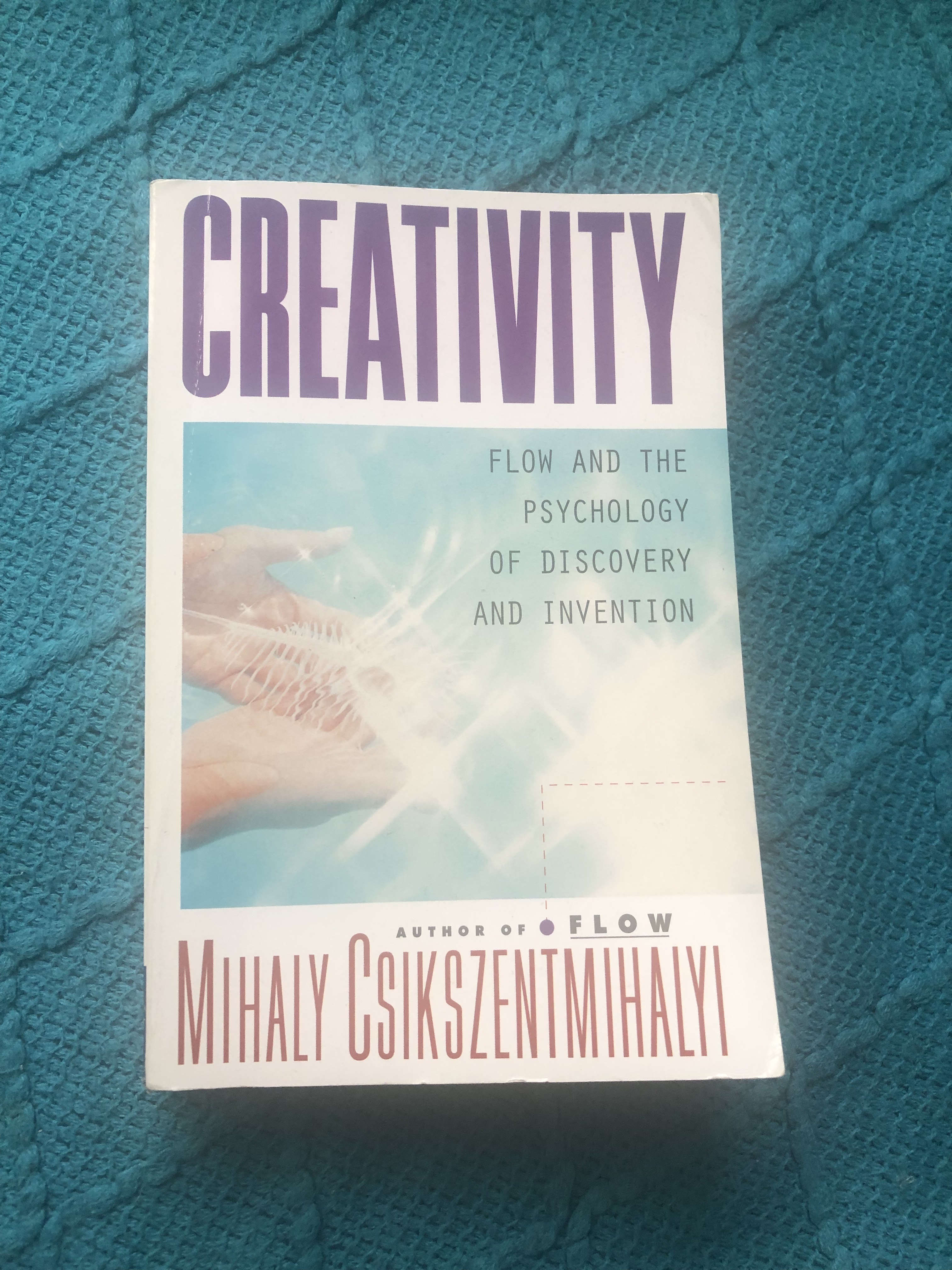
Book review – Creativity from Mihaly Csikszentmihalyi

This review was originally written for my Hungarian blog back in 2010, but as this book is a serious dose of inspiration for me and made a remarkable impact on my writing, it is worth including on Outside the bud too.

According to Mihály Csíkszentmihályi, the famous professor of Hungarian origin known for his work of Flow, the first and essential condition for creativity is to delve into the given domain: to learn all its aspects and rules, then put aside what you have learnt and try to surpass the classics. Because only the ones who have a thorough knowledge of a particular domain can create a new aspect of it with mashing up disparate notions to form an innovative theory.

Creativity covers several decades of research – interviews with scientists, artists, and company directors provided the most significant raw material for the development of the theory, in which historical, philosophical, psychological and anthropological aspects are present throughout. In addition to the definition, conceptual and conditional system of creativity, sectoral aesthetics, reflections and gems of everyday creativity also shine in the volume.

It is important to note that there is an example in the book in which the writer presents the importance of the domain experts’ attitudes to any new artwork with the help of a specific painter’s career path. The story clearly shows the important realization that the true value of a creative artwork always depends on the mental maturity and receptiveness of the particular domain’s circle of experts. Therefore not all remarkable inventions become widely successful at a given time – the artist needs to be in the right place at the right time and practice self-promotion to be known in the right expert circles of their domain.

I would recommend this book for any artists (novice and professional alike) who needs extra motivation and encouragement to push themselves further in their creative process to expand the boundaries of a particular domain. And for all the casual readers, this interesting writing will guide you in how to activate your inner creative side in everyday life activities.

Life mosaics

There is something special in overhearing other people’s conversations on public transport. You only get a limited amount of time next to strangers during travelling but can have insight about their life and their core values. Or you only capture a sentence of their conversation but that activates your mind to apply the listened aspects to your own life or wonder about how the heard things can be relevant in your current unsolved situation.

This morning’s journey was a prime example of this. When I got on the train towards London Victoria, I overheard a long conversation between a younger, very motivated guy and a quiet older man. I don’t usually listen to other people’s conversations but it caught my attention that the young guy was talking about Jesus and how this reflected in everything he does in his life. He was talking about corporate mission of embedding spirituality into even sparetime activities like football. I am neither religious nor spiritual, but it was good to hear that there are still people who believe in Gods and rituals and I really enjoyed listening to this information exchange. The young guy dominated the conversation and his passionate views about religion and his vision of the direction of his area was very motivational for me to hear. I reminisced about the time when I was part of a Buddhist group in SW London for a while but I never really believed that chanting one japanese sentence for half an hour can change my lifestate. Yet I loved the Buddhist philisophy of life especially the teachings about karma. One of the best thought on this was from president Ikeda:

“This is the time to surely and steadily create the causes for your future victory – to sow seeds that will bear fruit later. In planting a forest, some of the seeds might be carried away by birds. If that happens, just plant some more. Some of the young shoots that emerge may be destroyed by the elements. Again, just plant some more. As you repeat this process again and again, eventually you will create a vast forest. This is the principle of Buddhism.”

I also overheard one sentence on my way to the tube which was a very heavy topic at 8.00am on a Tuesday morning: “You are not getting any younger, are you?” This sentence always makes me wonder about my life decisions, especially nowadays as I am getting closer to 40 and so any decisions I make now would influence my next years tremendously.

Having known that I am in an emotional turmoil at the moment, I am very observant about any kind of information in my environment as I think we can learn from anyone in our lives and I strongly believe that overhearing certain things are not coincidences but life’s way of diverting us to certain paths. We just need to be opened to any information that crosses our path as one may be the missing puzzle that helps us to step into the best path possible….